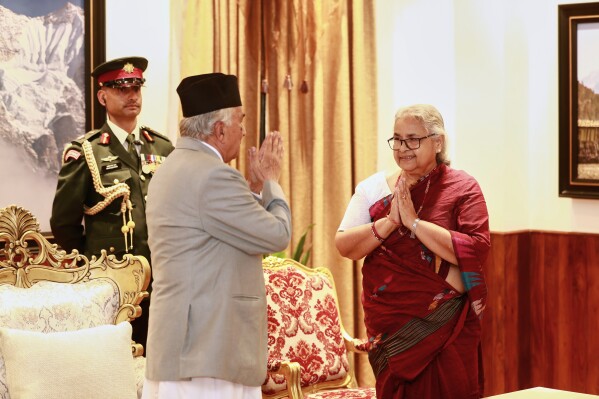

Nepal made history Friday as Sushila Karki, a 73-year-old former chief justice, was sworn in as the country’s first female prime minister, stepping in as interim leader after a week of unprecedented upheaval.
Her appointment follows a wave of youth-led protests that erupted over corruption and nepotism, ultimately forcing the resignation of Prime Minister K.P. Sharma Oli and plunging the nation into crisis.
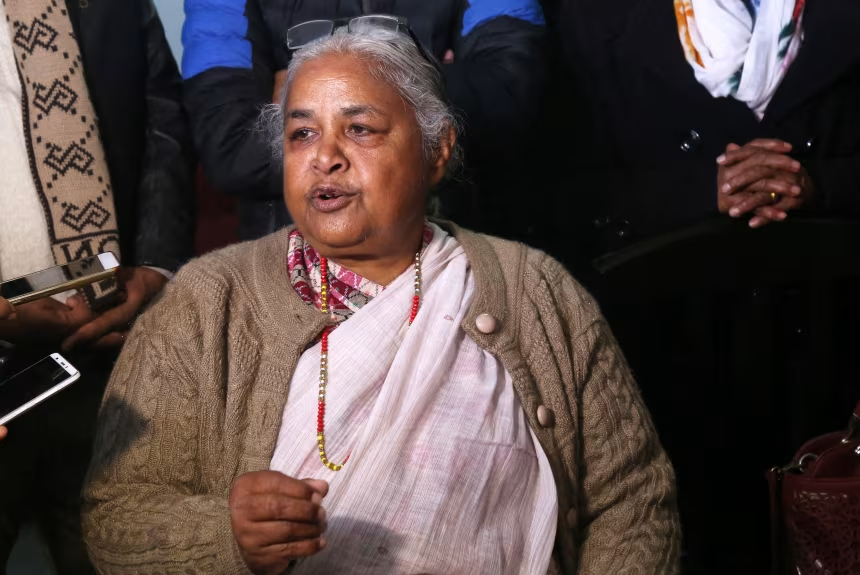
The movement, driven largely by Gen Z activists, began as a digital outcry against the extravagant lifestyles of politically connected elites, dubbed “Nepo Kids” but quickly escalated into violent street demonstrations, resulting in dozens of deaths and widespread unrest.
Karki emerged as the preferred candidate through an informal vote conducted on Discord, the messaging platform where much of the protest organizing took place.
Her reputation for judicial integrity and independence resonated with the demonstrators, who saw her as a symbol of reform.
India’s Ministry of External Affairs responded positively to the leadership change, expressing hope that Karki’s appointment would contribute to “peace and stability” in the region.
“As a close neighbour, a fellow democracy and a long term development partner, India will continue to work closely with Nepal for the well-being and prosperity of our two peoples and countries,” a statement from the ministry said.
READ ALSO: Nepal Crisis: President Seeks End to Chaos After Prime Minister’s Forced Resignation
President Ram Chandra Paudel has dissolved parliament following a recommendation from Karki, according to an official statement from his office.
Fresh elections are now set to take place on March 5, 2026.
Despite having built her career within the very institutions that have drawn widespread youth protests, Karki’s image as a bold and unyielding jurist has resonated strongly with many young citizens in the nation of 30 million.
“We want someone who has integrity and is not a political opportunist. She fits that category for us,” said Biraj Aryal, a 28-year-old aspiring chartered accountant, adding that Karki is “the only figure that the entire country can rely upon.”
“Since she has been a judge she is well versed with the laws and systems of the land. We are certain she can provide a safe landing for us out of this crisis,” he added.
“She has shown she has a spine,” 24-year-old law student Anjali Sah told CNN. “She is also the first female justice of Nepal and we are hoping that a woman leading this country will help set things in order and reduce corruption.”
Binay Mishra, a Kathmandu-based public policy analyst, said Karki “has lately become very vocal, particularly about the politicization of judiciary and how judges are being appointed partially.”
He noted that her stature has significantly risen in recent months.
Hailing from the Morang district in eastern Nepal, Sushila Karki carved out a distinguished legal career that culminated in her groundbreaking appointment as Nepal’s first female chief justice in 2016.
Her tenure was marked by a firm stance against corruption, earning her a reputation for judicial integrity.
Just a year into her role, Karki’s bench overturned the government’s nominee for police chief, a move widely interpreted as a stand for meritocracy over political favoritism.
In response, the ruling coalition launched an impeachment motion against her.
However, the attempt was swiftly abandoned following widespread public outrage and pushback from the judiciary, further cementing her image as a defender of institutional independence.
Meanwhile, public frustration in Nepal has been simmering for years, fueled by soaring youth unemployment and deepening economic inequality.
Many citizens feel alienated by the growing divide between the political elite and ordinary people.
The current wave of unrest erupted in early September, when young Nepalis, angered by social media posts flaunting the lavish lifestyles of politicians’ children, organized peaceful demonstrations.
Tensions escalated dramatically after the government imposed a sweeping ban on over two dozen social media platforms, including Instagram, Facebook, and WhatsApp.
In a dramatic turn of events, protesters set fire to the parliament and Supreme Court, two pillars of the state, prompting Prime Minister K.P. Sharma Oli to step down.
According to Nepal Police spokesperson Binod Ghimire, 51 people have died in the clashes, including 21 protesters, 3 police officers, and 27 others.
The Ministry of Health and Population reports that more than 1,700 individuals have been injured.
(CNN)
Follow the Parallel Facts channel on WhatsApp: https://whatsapp.com/channel/0029VaCQSAoHgZWiDjR3Kn2E